


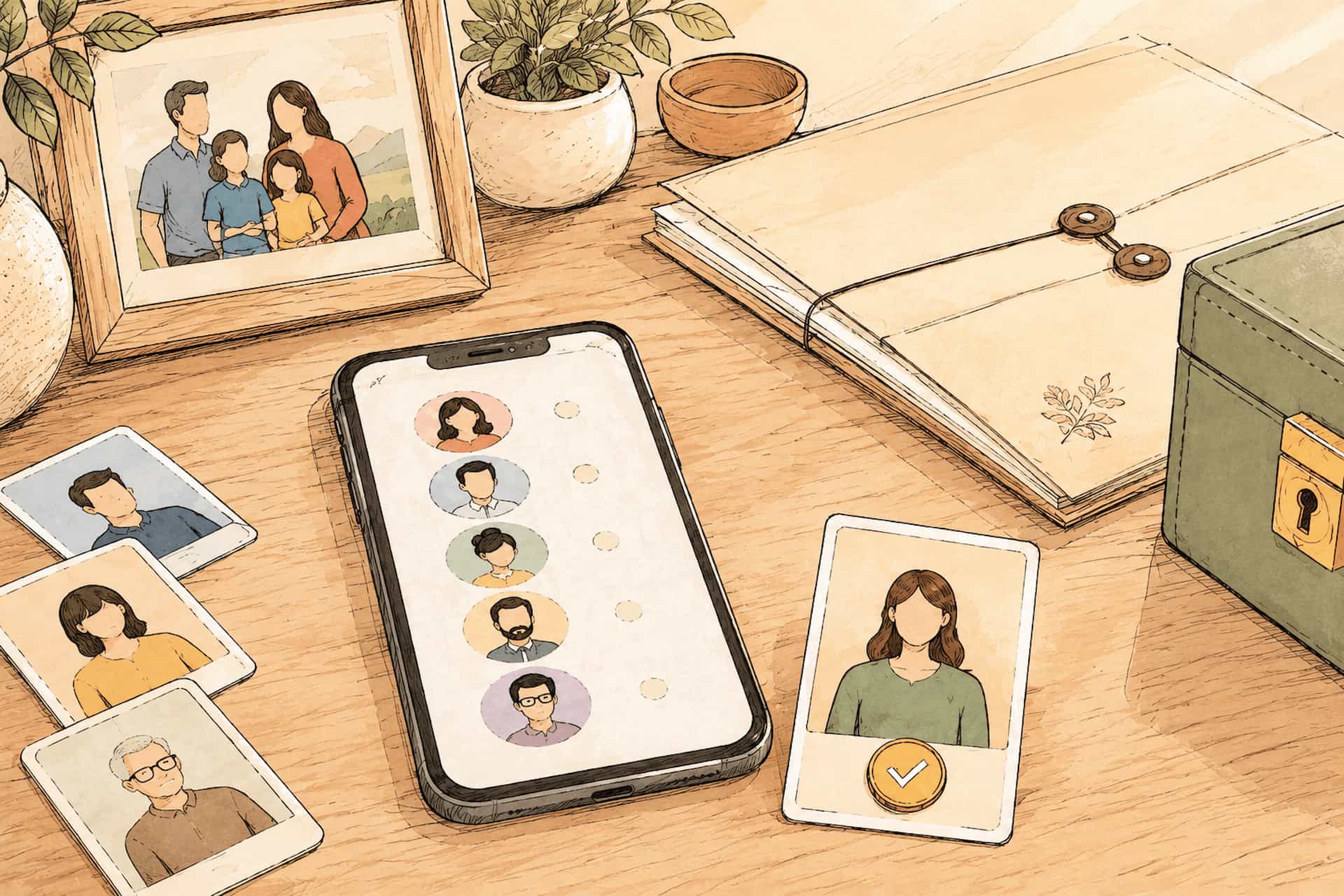

All those planning ahead, thinking about end-of-life or care situations, eventually face the question: Who should be my trusted contact?
Here is what we think you need to know and how Meolea helps you select the right one!
What even is a trusted contact?
A trusted contact is the person who steps in when you can’t and makes important decisions on your behalf.
From medical decisions when you cannot express them yourself, to handling your estate or contacting others who need to get involved, all of this is handled by your trusted contact.
Most people default to their spouse, their eldest child, or whoever lives closest, without thinking through what the role actually requires. Choosing well matters more than choosing fast, because this is the person who will carry real responsibility, sometimes years before anything happens, and almost certainly during one of the hardest weeks of their life.
A trusted contact is not the same as your next of kin
Legal next of kin and the right trusted contact are often two different people, and treating them as interchangeable is one of the most common planning mistakes.
“Next of kin” is a legal default and decided by your relationship, not by whether they are the best person for the tasks involved. Your trusted contact is a role you assign on purpose. It can be your partner, but it can just as easily be a sibling who lives further away but stays calmer under pressure, or a close friend who already knows where you keep everything important.
The role isn’t about who loves you most. It’s about who can act clearly, follow instructions, and hold information responsibly while everyone around them is grieving.
What the role actually involves
A trusted contact needs to be reachable, organized, and willing to act on your behalf, not just emotionally close to you.
In practice, this can mean locating documents, notifying banks and insurers, following funeral wishes you’ve already written down, and later, delivering letters or messages you’ve prepared for specific people. None of this requires legal training. It does require someone who won’t freeze, won’t avoid the task out of grief, and won’t quietly decide your wishes were “just a suggestion.”
It’s worth being honest about who in your life fits that description. The person you’d call first in an emergency isn’t always the person best suited to executing a plan calmly over several weeks.
You can choose more than one, and you should think about reveal timing
Naming a single trusted contact for everything is rarely the right structure, because different people are suited to different parts of the role.
One person might be best placed to handle financial and legal matters. Another might be the right person to receive a personal letter or know about something more private. Splitting responsibility this way also protects you: a trusted contact only needs access to what’s relevant to their part, not your entire life, and not before it’s the right moment.
This is also where reveal settings matter. A trusted contact being named doesn’t mean they see everything immediately. You decide what becomes visible, to whom, and when, whether that’s now, after your passing, or somewhere in between. The role and the access are two separate decisions, and you’re free to set them independently.
How to actually decide
The clearest way to choose is to ask who would handle a stressful, unfamiliar task well, not who you’d want comfort from.
A short, practical way to think it through: who has handled a difficult administrative situation calmly before? Who lives close enough, or is reachable enough, to act within days. Who would follow your wishes even if they personally disagreed with one of them? The answers won’t always point to the same person, and that’s fine. It’s exactly why the role can be split.
If you haven’t named a trusted contact yet, or you’re not sure the people you’d assume are still the right fit, it’s worth revisiting. Meolea lets you assign trusted contacts by role, set what each one can see and when, and update it any time your circumstances change. See how it works.