


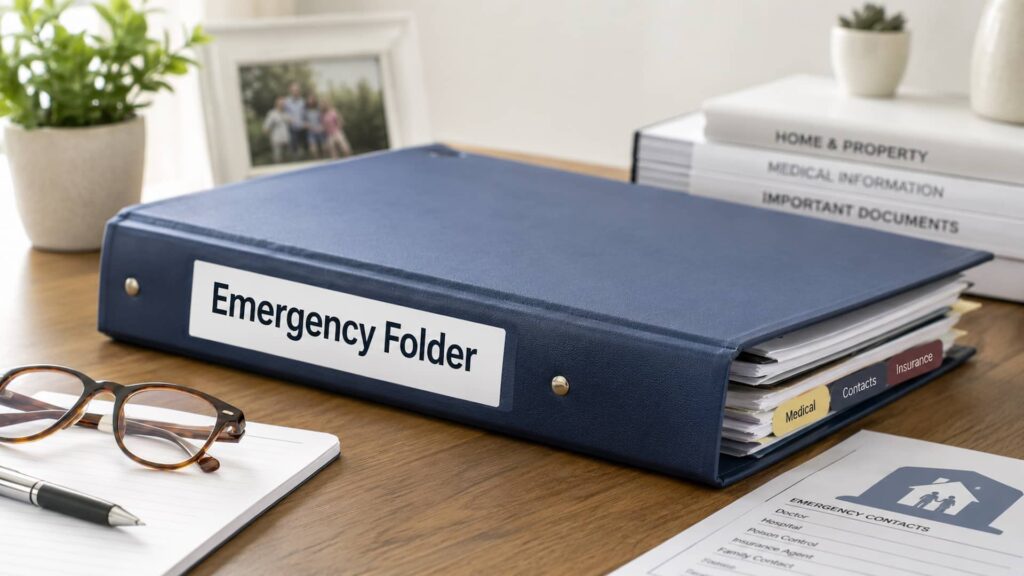
An emergency folder – also called an emergency binder – is a single, organised collection of documents, contacts, and information your family can turn to when they need to manage things on your behalf.
Most people have more of this than they realise. A will somewhere, insurance policies in an email, a pension letter in a drawer, medical details that only they know. The problem is not usually that the information does not exist. It is that nobody else can find it.
An emergency folder brings it all together in one place, so the people you trust do not have to search.
What is an emergency folder?
An emergency folder is a practical collection of essential documents and information that can be accessed quickly in urgent situations.
It is not a will. It is not a legal document. It does not replace a power of attorney or an advance directive. It works alongside all of those as the layer that makes everything else findable and usable.
Think of it as the answer to one simple question: if something happened to you today, would the people you love know where to find everything? Not just the documents, but the contacts, the accounts, the passwords, the wishes?
If your honest answer is no, then setting up an emergency folder can change that.
Who needs an emergency folder?
Anyone who has people in their life who would need to manage things on their behalf should have an emergency folder, no matter their age or current state.
It is easy to assume this is something for later in life. But the need for it has nothing to do with age. It has to do with whether someone depends on you, whether you have accounts and assets someone else might need to access, and whether the people you love would know what to do if something unexpected happened.
If the answer to any of those is yes, an emergency folder is worth having.
If you own property, have a bank account, pay bills, have children, or have anyone who would need to manage your affairs, you need an emergency folder!
What should go in an emergency folder?
A complete emergency folder covers five areas: personal documents, financial and legal information, medical details, digital access, and personal wishes.
Here is what each one includes.
1. Personal documents
The basics that confirm who you are and your key life events: passport, birth certificate, marriage or civil partnership certificate, any relevant residency or citizenship documents.
2. Financial and legal documents
Your will, power of attorney, bank account details, pension documents, insurance policies (life, health, home, car), property information, and the contact details for any accountant, solicitor, or financial advisor involved in your affairs.
3. Medical information
Your GP’s details, any current diagnoses, medications and dosages, allergies, and any advance care directive you have in place. This section matters most in situations where things happen quickly.
4. Digital access
One of the most commonly missed areas, and one of the most frustrating for families without it. A note of where your important accounts are held, how to access a password manager, and any digital assets worth knowing about.
A note on passwords: do not write passwords directly into a document that many people might see. Instead, note where the passwords are stored (for example, in a digital password manager), and make sure at least one trusted person knows how to access it.
5. Personal wishes
This is often the part people underestimate. It does not need to be long. Funeral preferences, who should be contacted first, and anything you want specific people to know or receive. On Meolea, this is also where you can write personal letters to the people you love, record parts of your life story, and set exactly when and how those things are shared — so the folder becomes something more than a filing system.
You can find a complete overview in our emergency folder checklist.
Where should you keep it?
Your emergency folder works best in two forms: something physical at home, and something digital that trusted people can reach from anywhere.
A physical folder covers the basics. In most cases, this is a binder, a labelled envelope, something kept with your solicitor or in a home safe. But it only works if someone is there, knows where to look, and can get to it.
A digital version solves the gap. If the people who need this information are in another city, or if something happens while you are away from home, having it accessible online makes the difference.
Meolea is built for exactly this: one place where your documents, your contacts, your wishes, and your personal messages live together. You decide who can see what and when — not just a shared folder, but a structured handover with the right information reaching the right people at the right time.
For a closer look at the options, see our guide on physical vs digital emergency folders.
How to set up an emergency folder
Setting up an emergency folder takes less time than most people expect. The key is to start somewhere rather than wait until it feels like the right moment.
Begin with the three things that would cause the most disruption if they could not be found: your most important personal documents, your main financial contacts, and the name and number of the person your family would need to call first. That is already more than most people have in place.
From there, work through each area at your own pace. Add short notes where things need context — where an account is held, what a document means, who to call about what. Then decide where it will live and who will have access to it.
The most important step is making sure at least one person knows it exists and knows how to reach it.
Is an emergency folder the same as a will?
No. A will tells people what you want to happen to your estate. An emergency folder tells them how to manage everything in the days and weeks that come first.
The two are not alternatives; they work together. A will is a legal instruction. An emergency folder is a practical guide. Many families discover that even a carefully prepared will is hard to act on quickly if nobody can find the insurance policy, access the bank account, or reach the right contacts.
The emergency folder is what makes the rest workable.
For a full comparison, see our guide on emergency folders vs wills.
Start your emergency folder
The best emergency folder is the one that actually exists. Start with what you have, and build from there.
Meolea gives you a guided structure to bring everything together: your documents, your estate information, your wishes, and your personal messages to the people who matter most. You set who has access and when. When the time comes, your family has what they need — clearly, calmly, without having to search.
More Helpful Tips For Your Emergency Folder
These articles go deeper into each part of the emergency folder. We add more regularly.


Frequently asked questions about emergency folders
Does an emergency folder need to be notarised or witnessed?
No. It is a practical reference, not a legal document. You can put one together yourself today, without any professional involvement. Some of the documents inside it — a will or a power of attorney, for example — do need to meet legal requirements on their own, but the folder itself does not.
Should I tell my family it exists?
You do not need to share everything with everyone. What matters is that the right people know the folder exists, know where to find it, and know they have permission to use it. You choose who that is and how much they can see.
What if I do not have a will yet?
The folder is still worth creating. Your documents, your medical information, your contacts, and your wishes are all useful regardless of whether you have a formal will in place. Many people find that putting together an emergency folder is exactly what motivates them to finally sort out their will too.
What is the difference between an emergency folder and an end-of-life plan?
An emergency folder is the practical, immediately accessible layer — documents, contacts, accounts, wishes. An end-of-life plan is broader and may include advance care directives, funeral planning, a personal life story, and letters to loved ones. Meolea holds both: the practical information your family needs right away, and the personal content that connects them to you, delivered at the right time in the right way.
How often should you update your emergency folder?
Review your emergency folder once a year, and any time there is a significant life change. The most useful emergency folder is a current one. Outdated information can be just as disorienting for a family as no information at all.
A useful habit is to link the review to something you already do annually, like filing your taxes or renewing your home insurance.
What’s the difference between an emergency folder and an emergency binder?
They are essentially identical; however, some people like to refer to their physical version as the “emergency binder”, whereas the digital one is usually called an “emergency folder”.