



Most people assume technology has solved this. It has not. Understanding why is the first step toward making things easier for the people you love.
Your bank account, your insurance policy, your Spotify subscription can all be closed after your passing with a single notification letter and a copy of the death certificate. Your Instagram, your LinkedIn, your Facebook each require their own form, their own documentation, their own process. There is no guarantee of a smooth outcome.
The institutions we tend to think of as old-fashioned have a cleaner, more predictable path for handling death than the platforms we use every day. That is not an accident. And understanding why it is still this way helps you prepare in a way that actually makes a difference for your family.
There is no standard process for digital accounts after death
No central system registers a death and notifies your platforms. Each operates independently, under its own rules, with its own documentation requirements.
When someone passes away, their online accounts do not close automatically. There is no equivalent of a death registry for the digital world. No notification goes out. Each account simply continues to exist until a family member or executor finds it, works out the relevant platform’s process, gathers the required documentation, and submits a request.
For some platforms, that process is manageable. For others, it involves weeks of back-and-forth with support teams, documents that need to be certified, and forms that were clearly not designed with grieving families in mind.
The practical work of managing someone’s digital accounts often falls to people who are already dealing with more than enough. It is one of the more avoidable parts of what follows a loss, if the right preparation is in place.
💡 For a full breakdown of what each major platform requires, read our guides on what happens to your social media accounts when you die and what happens to all your online accounts when you die.
Why your bank is easier to deal with after death than Facebook
Traditional institutions have been legally required to build standardized processes for handling death. Tech platforms largely have not, and the difference is felt most by the families left to manage the accounts.
This is the part that surprises most people. The institutions that feel most bureaucratic in life tend to be the most straightforward after a passing.
Banks have legal obligations around estate management. Insurers have claims processes built around exactly this moment. Utility companies and subscription services like Netflix or Spotify accept a death notification email with an attached death certificate, and a support team handles the rest. None of that requires the account’s original login details. In principle, any executor or authorized family member can handle it without needing to know the platform’s internal process in advance.
In the UK, the government has gone further. The Tell Us Once service allows families to notify most central and local government departments in a single step, covering everything from HMRC to the DVLA to local councils. A separate Death Notification Service handles UK banks and building societies through a single submission. One process, dozens of notifications.
The US and the EU have no general equivalent. A death must be registered at the local civil registry office, which notifies some government bodies, but families are still responsible for contacting each institution individually. Banks, insurers, pension providers, and utility providers each need to be contacted separately.
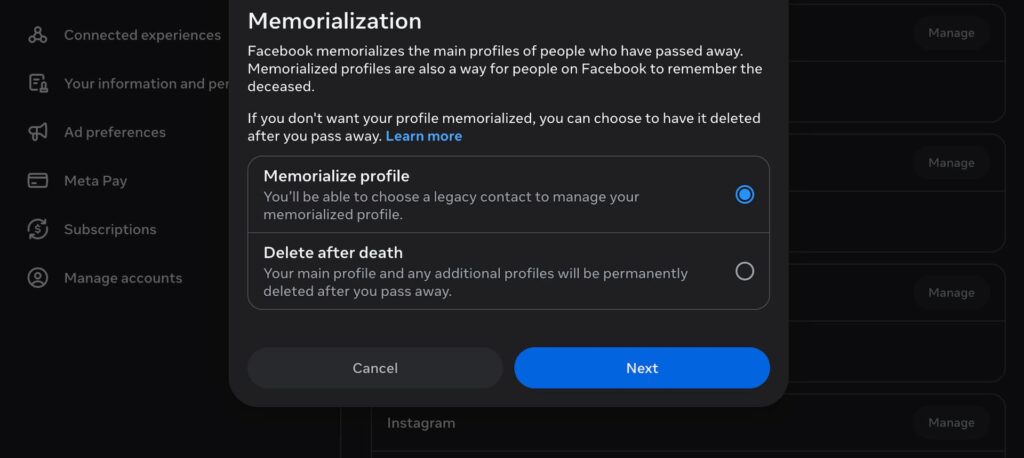
Tech platforms are further behind still. Facebook’s memorialization process works one way. LinkedIn’s account closure works another. X, formerly Twitter, has no memorialization option at all. TikTok’s process is separate again. None of these systems accept a standard notification format. None have opened their processes to outside tools or integrations.
The reason traditional institutions are more manageable is simple. Regulation and legal obligation pushed them to build standardized death processes over decades. Tech platforms had no equivalent pressure and largely did not build them.
Can AI help with this?
AI tools can take on some of the practical work involved, but every major platform still requires a person to initiate the process, and no tool has changed that.
This is a question worth answering directly, because the answer is more nuanced than a simple yes or no.
An AI tool that can navigate websites and fill in forms on your behalf could, in principle, work through a list of accounts, complete the relevant forms on each platform, and send cancellation emails to subscription services. For the parts of the process that involve repeating the same information across many different forms, this kind of assistance is genuinely useful.
But three things stand in the way of full automation, regardless of how capable the technology is.
No platform has built a way for outside tools to manage accounts after death. Facebook, Instagram, LinkedIn, TikTok, Google, Apple: none of them have created a way for outside software to submit a death notification and trigger the relevant actions automatically. Every process still requires a person to initiate it, through a manual form or support request. An AI tool hits the same wall a human does.
The death certificate cannot be obtained automatically. Every platform that offers any kind of post-death account management requires official documentation. The death certificate is issued by a government authority, takes days or weeks to arrive after a passing, and must be submitted by a person. No tool can generate or retrieve this document.
Someone has to start the process. An AI tool needs to be told that someone has passed away. It cannot know on its own. A trusted contact still needs to initiate the process with the relevant documentation in hand.
The closest thing to an automated path that currently exists is Google’s Inactive Account Manager. This lets you specify what happens to your Google data if your account goes unused for a set period of time. But it is triggered by inactivity, not by a death, and it is entirely self-contained within Google. No family member or third-party tool can access or build on it.
The honest picture: the wall is not about what AI can do, but that platforms have not built a way for anyone to handle this programmatically. Until that changes, the process stays manual for everyone.
What preparation actually changes
The single most useful thing you can do is make sure your family knows what accounts you have and what you want done with them, before they ever need to act.
No tool removes the manual work involved in closing digital accounts after a passing. But preparation removes the uncertainty that makes that work so much harder.
The families who manage this well tend to have three things in place before they ever need them.
A clear account inventory. Your family cannot close accounts they do not know exist. A simple record of your main accounts — social media, email, cloud storage, subscriptions, financial — with notes on what you would like done with each one removes one of the biggest sources of confusion and delay.
A trusted contact who knows what to do. Someone who is aware of your wishes, knows where to find your records, and is authorized to act on your behalf. This does not need to be a lawyer. It can be anyone you trust with the practical side of things.
Documented wishes for the accounts that matter most. Some accounts you may want memorialized. Others you may want closed. Some content you may want preserved or passed on. Recording this in advance means your family is not guessing at a moment when guessing is the last thing they need.
Meolea is built around exactly this preparation. You can record your account details, document your wishes, appoint trusted contacts, and set up the access they will need — all in one place, private by default. When the time comes, your family has a clear starting point rather than a blank page.
You can start your digital accounts inventory, document your wishes, and set up access for your trusted contacts for free.
Frequently asked questions
Can AI automatically close my accounts when I die?
Not currently. AI tools can assist with parts of the process, but every major platform still requires a person to initiate the request and provide official documentation. No automated path exists for this. For a fuller explanation, see the section above.
Why don’t social media platforms have a simpler process?
Most platforms built their processes for deceased users as afterthoughts rather than core features. Unlike banks and insurers, which face legal obligations around estate management, tech platforms have had little regulatory pressure to standardize. The result is a fragmented set of policies that vary between platforms and change without notice.
Is there a service that handles all death notifications at once?
In the UK, the government’s Tell Us Once service handles notifications to most central and local government departments in a single step, and a separate Death Notification Service covers banks and building societies. In the US and EU, no equivalent service exists. Each institution needs to be notified separately, which is why having an account inventory prepared in advance makes such a practical difference.
Which accounts are easiest and hardest to handle after death?
Generally, the easiest are those with standardized institutional processes: banks, insurers, pension providers, utility companies, and subscription services. These typically accept a death notification with a death certificate attached. The hardest tend to be social media platforms, which each have proprietary processes, varying documentation requirements, and unpredictable timelines.
What does my family actually need to manage my digital accounts?
In most cases: multiple copies of the death certificate, proof of their relationship to you or authorization to act on behalf of the estate, a list of which accounts exist, and your wishes for each one. Having all of this prepared in advance makes a significant practical difference.
Does Meolea automate account closure?
It depends on the type of account. For institutions with standardized processes (banks, insurers, and subscription services), we are building toward automated handling so your family does not have to contact each one separately. For social media platforms, no external tool can currently automate this, because the platforms themselves have not built a way to allow it. What Meolea does in every case is make sure the preparation is in place: a clear record of your accounts, your wishes for each one, and the access your family needs when the time comes.